The Unsung Hero
I’ve always heard Vashti described as the "villain" of the opening act. She was the rebellious wife. The difficult woman. The one who ruined the party. Her story was told as a cautionary tale: Don’t be like Vashti, or you’ll lose your crown. But when I re-read Chapter 1 as an adult—and as a woman—I don’t see a villain. I see a victim of a system built on power, alcohol, and objectification. And more importantly, I see a woman with a spine of steel. It’s time we give Queen Vashti her due.
Context is King
Let’s look at the context. King Xerxes throws a party that lasts for 180 days for his officials, followed by a 7-day bender for the entire city. The text explicitly tells us that "royal wine was abundant" and drinking was the main event.
Nurse’s Note: If a patient presented like King Xerxes—making major life decisions after 7 days of heavy drinking—we wouldn't call him authoritative; we would call him compromised.
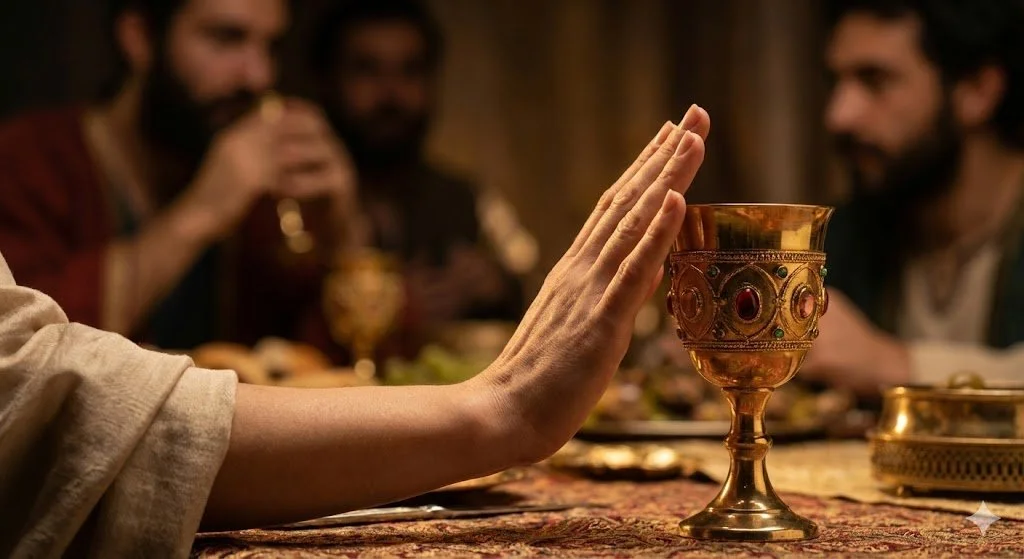
In his drunken state, he commands Queen Vashti to come out wearing her royal crown "to show the peoples and the princes her beauty" (Esther 1:11). This wasn't a request for a polite introduction. This was a demand for her to be paraded like a trophy before a room full of intoxicated men. Vashti did something unthinkable for this time period.
Vashti said “NO.”
In the Persian Empire, the King’s word was law. To refuse him was to risk death. But Vashti knew that her dignity was worth more than her title. She refused to be an object, even if it meant she could no longer be a Queen. She knew the consequences. “This made the king furious, and he burned with anger.” Maybe I am being vulnerable here, speaking from my own toxic past relationships, but refusing an insecure man isn’t just seen as a 'no'—it is often taken as an insult to his pride, and in some cases, his 'manhood.' We see that reaction here CLEARLY. The King didn’t just get mad; he got insecure. His advisors told him that if Vashti got away with this, all women would start respecting their husbands less. So, they passed a law demanding respect. (If you have to pass a federal law to make your wife respect you, you have already lost.)
God in the Brokenness
So where is God in this objectifying chapter? This is the hardest part of the book to swallow: Vashti was punished for doing the right thing. She lost her home, her status, and likely her access to her children (if she had any). It feels unfair because it is unfair. But here is the "Cracked Vessel" truth: God does not waste the wreckage.
The Bible describes this injustice, but it does not endorse it. I have seen the Bible is descriptive, not prescriptive. Just because the Bible describes the King treating women like property doesn't mean it prescribes that behavior as God's will. The author isn't saying, 'This is how it should be.' He is simply recording the broken, dangerous reality of the Persian court that Esther is about to step into.
The world punishes dignity, but God uses the broken pieces.
Instead of endorsing the King's cruelty, the story shows us how God used Vashti’s brave 'No' to create the vacancy that Esther would eventually fill.
Without Vashti’s refusal, the throne is never empty.
Without the empty throne, Esther never becomes Queen.
Without Esther as Queen, the Jews are destroyed.
Vashti was the first domino in God's rescue plan. She sacrificed her crown to save her dignity, and unknowingly, that sacrifice paved the way for the saving of a nation.
The Cost of Integrity
The sad reality the world we live in constantly pressures us to compromise to get ahead—to laugh at the inappropriate joke, to stay silent when we should speak up, to "go along to get along"—Vashti stands as a reminder that integrity has a price tag. Sometimes, doing the right thing costs you the "crown." It might cost you a promotion, a relationship, or your popularity. But Vashti teaches us that keeping your soul is worth losing the world.
A Prayer for Courage
"Lord,
Thank You for the example of Vashti, who chose dignity over the worldly Kingdom. Give me the courage to say 'No' when the world demands I compromise who I am. When I am pressured to be an object rather than a person, help me to stand firm. I pray for those who have lost 'crowns' because they refused to do the wrong thing. Comfort them with the knowledge that You see their sacrifice. Use my small acts of integrity to pave the way for Your greater plans, even if I can't see how they fit together yet.
Amen."
Reflection Question: Has there ever been a time in your life where doing the right thing cost you something valuable? How do you view that loss now?
Next Up: We’re entering the "Meat Grinder." Why Esther’s beauty treatment wasn't a spa day, and how to find grace in the darkest rooms.