Nahafochu
The Dinner Party from Hell
We have arrived at the climax. Esther invites the King and Haman to a second banquet. The tension is palpable. Haman thinks he is the guest of honor; Esther knows he is the defendant. When the King finally asks Esther, "What is your petition?", she drops the mask. She doesn't ask for money or power. She identifies herself with the condemned. She says,
"For we have been sold, I and my people, to be destroyed, to be killed, and to be annihilated" (Esther 7:4).
The King demands to know who would dare do such a thing. And then comes the moment that shifts the atmosphere of the entire room. Esther points a trembling finger across the table:
"The adversary and enemy is this wicked Haman!"
DUN DUN DUNNNNNNNNNNNN!!!
The "Couch" Incident
What happens next is pure chaos. The King storms out in a rage to the garden. Haman, realizing his life is over, stays behind to beg Esther for mercy. In his terror, Haman falls onto the couch where Esther is reclining. (This is full decompensation. The man who demanded the world bow to him is now groveling at the feet of a Jewish woman.) The King walks back in at that exact moment and sees Haman on top of the Queen. He misinterprets it as an assault, shouting, "Will he even assault the queen in my presence, in my own house?" (But is it a misinterpretation or was it God ;)). It is the final nail in the coffin. They cover Haman’s face. It’s over.
The Definition of Nahafochu
But the execution of Haman isn't just justice; it is poetic irony. One of the King’s attendants (shoutout to Harbonah!) points out the window: "Look! The gallows, fifty cubits high, which Haman made for Mordecai... is standing at Haman's house."
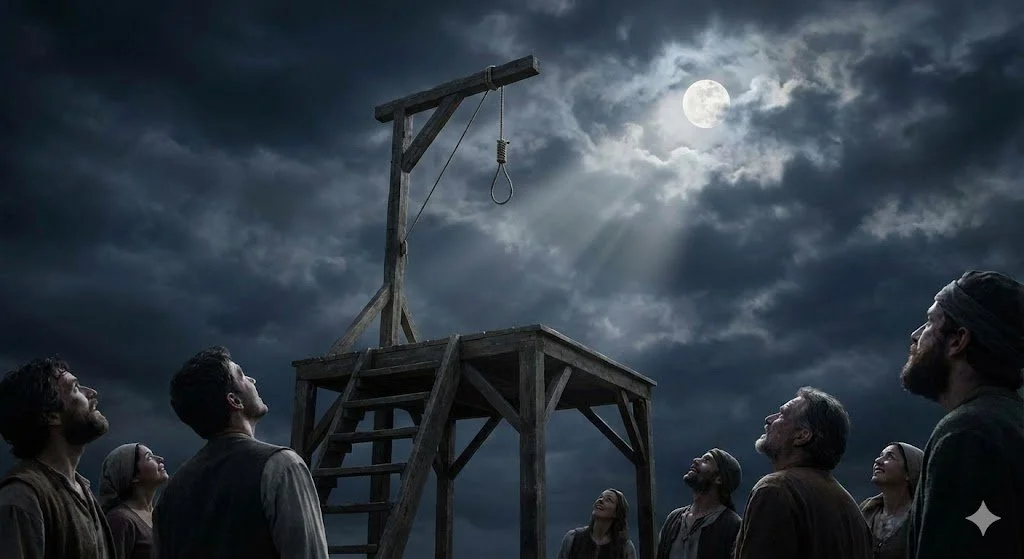
The King’s response is swift:
"Hang him on it."
This brings us to the most important word in the entire Book of Esther, found in Chapter 9:1. It is the Hebrew word Nahafochu. It translates to: "It was turned to the contrary" or "It was flipped upside down." It refers to the moment where sorrow was turned to gladness, and mourning into a holiday. God didn't just stop the enemy; He reversed the scheme entirely.
This is the theme of the book.
The gallows built for Mordecai killed Haman.
The ring given to destroy the Jews was given to Mordecai to save them.
The Boomerang Effect
In physics, for every action, there is an equal and opposite reaction. In the Kingdom of God, there is the Nahafochu Effect.
We see this pattern all throughout Scripture:
Joseph is thrown into a pit, only to rule Egypt.
The Cross, meant to kill Jesus, became the instrument that killed Death.
God loves a plot twist. He loves to wait until the odds are impossible, until the decree is signed and the gallows are built, just to show that He can turn the whole thing upside down in a single afternoon. Maybe you are reading this and you feel like the decree has already been signed against you. Maybe the doctor’s report is bad, the bank account is empty, or the relationship is dead. You are looking at a "gallows" in your life. The God of Esther is the God of Nahafochu. He is the God of the Turnaround. He can take the very thing meant to destroy you and turn it into the thing that delivers you. The story isn't over until the King speaks. And your King is still on the throne.
A Prayer for the Turnaround
"Lord,
I praise You as the God of Nahafochu. You are the God who turns mourning into dancing and sorrow into joy. I bring my 'gallows' to You today—the situations that look hopeless and the decrees that stand against me. I ask for a holy reversal. Flip the script in my life. Let the plans of the enemy backfire. Let the very things meant to harm me be used for my good and Your glory. I trust that it is never too late for You to turn it around.
Amen."
Reflection Question: Where do you need a "Nahafochu" moment in your life right now? What "gallows" are you facing that God could turn into a victory?
Next Up: We wrap up the series with the legacy of Purim—and why we are commanded to party in the face of survival.